Baronleo Anello Chevalier Inciso
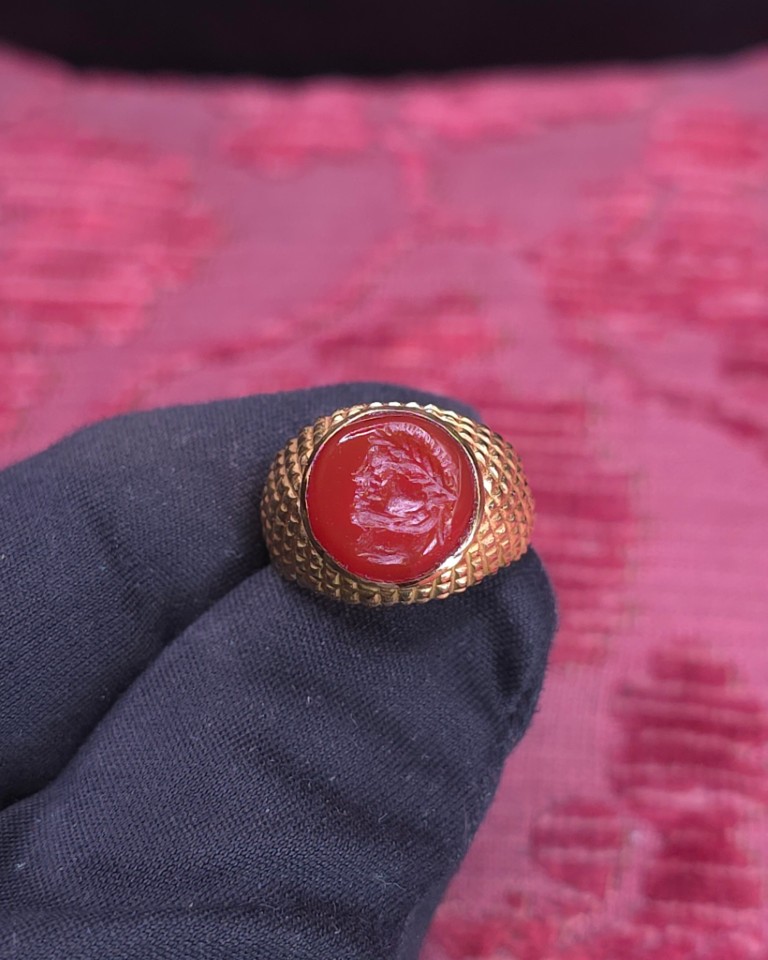
VIDEO – This 18-karat gold Chevalier ring is not just any Chevalier, but a unique and unrepeatable piece in solid 18-karat gold (15.6 grams), measuring 15 x 13 mm, entirely engraved with a burin, depicting a rampant lion, a baron’s crown, and flourishes on the sides. It is crafted using one of the oldest and most fascinating goldsmithing techniques: cuttlefish bone casting. This method, dating back to at least the 6th century, is completely natural, sustainable, and—importantly—absolutely cruel to the cuttlefish. The pattern is impressed or engraved directly into the spongy part of the bone, a soft surface that accommodates every detail of the design. The two halves are then perfectly matched, joined, and traversed by a small funnel-shaped channel through which the molten metal is poured. When gold fills the cavity, it comes to life: it takes on the imprinted shape and retains the characteristic organic striations of the cuttlefish bone, those ancient veins that no modern technology can imitate. In some cases, micro-irregularities are intentionally left on the inside, giving the ring the patina of a rediscovered object, as if emerging from a trunk of the Serenissima. And this is where its true rarity lies:
the bone mold is disposable. Once the gold is poured, it burns. It can never be replicated. Every ring created with this technique is therefore unique in the world, unrepeatable by nature, irreproducible even by the craftsman who created it. A jewel that is not just a chevalier, but a fragment of Venetian history forged in the present.
Dear customer, this jewel may not be available immediately, but it is reproducible and customizable
Description
VIDEO This 18-karat gold Chevalier ring is not just any Chevalier, but a unique and unrepeatable piece in solid 18-karat gold (15.6 grams), measuring 15 x 13 mm, entirely engraved with a burin, depicting a rampant lion, a baron’s crown, and flourishes on the sides. It is crafted using one of the oldest and most fascinating goldsmithing techniques: cuttlefish bone casting. This method, dating back to at least the 6th century, is completely natural, sustainable, and—importantly—absolutely cruel to the cuttlefish. The pattern is impressed or engraved directly into the spongy part of the bone, a soft surface that accommodates every detail of the design. The two halves are then perfectly matched, joined, and traversed by a small funnel-shaped channel through which the molten metal is poured. When gold fills the cavity, it comes to life: it takes on the imprinted shape and retains the characteristic organic striations of the cuttlefish bone, those ancient veins that no modern technology can imitate. In some cases, micro-irregularities are intentionally left on the inside, giving the ring the patina of a rediscovered object, as if emerging from a trunk of the Serenissima. And this is where its true rarity lies:
the bone mold is disposable. Once the gold is poured, it burns. It can never be replicated. Every ring created with this technique is therefore unique in the world, unrepeatable by nature, irreproducible even by the craftsman who created it. A jewel that is not just a chevalier, but a fragment of Venetian history forged in the present.